


Provident Charter School's Curriculum Goals
The Provident Charter School curriculum is rooted in Pennsylvania Core standards and guides academic instruction in all content areas and at multiple levels. Provident Charter School strives to continuously strengthen and enhance curriculum, instruction and assessment to enable students to be:
- intellectually, physically, and emotionally healthy individuals;
- engaged, responsible, and informed citizens capable of considering multiple perspectives;
- college- and career-ready with a deep understanding of the soft skills necessary to collaborate effectively in an increasingly interdependent world;
- able to demonstrate perseverance, compassion, and self-control in pursuit of lifelong learning and growth.
Criteria for a Rigorous and Relevant Curriculum
Rigor and relevance is characterized by content that is linked to core disciplinary concepts or skills and requires students to do authentic work, using methods that are specific to the discipline and applying what they know or what they are learning to solve complex problems. This involves the use of prior knowledge, the development of in-depth understanding, and the ability to develop and express ideas and findings through elaborated communication. A rigorous and relevant curriculum requires students to use knowledge to create and apply solutions to complex, real-world problems.
- Concepts, competencies, and enduring understandings are applied to real world problems. Students at Provident Charter School are asked to apply discipline specific concepts and processes to address real world problems or complete authentic tasks. This approach provides opportunities for students to engage in deeper learning and encourages knowledge transfer. Curriculum, instruction, and assessment reflects an understanding by teachers and students of the value of applying concepts and competencies to impact the world around them.
- Opportunities for students to engage in higher order thinking are present throughout instruction. The instruction and the learning activities presented to students require them to analyze, evaluate, hypothesize, interpret, justify, and create deeper levels of understanding to be successful.
- Concepts, competencies, and enduring understandings are formatively assessed using PA Core standards, criteria, and a variety of formal and informal strategies. Learning objectives are clearly defined and unpacked, models of high quality work are reviewed, and rubrics are frequently and consistently applied. To help students achieve the learning objectives, their progress is closely monitored and responsive instruction is delivered. Students are provided meaningful feedback from both the teacher and their peers based on the pre-defined goals and/or criteria for the task. Students are provided access to a portfolio of their work that demonstrates progress toward mastery of learning objectives.
- Deep understanding and progression toward mastery of critical disciplinary concepts and competencies are demonstrated. The goal of all curriculum and instruction is for students to develop an integrated, holistic understanding of key concepts. Students are able to explain problems, nuances, and multiple applications of important disciplinary concepts, rather than only presenting narrow views or performing singular applications.
- The coherence of disciplinary enduring understandings and a culture supporting high expectations is consistent among all grade levels. Teachers within a content area have developed a universal understanding of the key concepts and competencies within their discipline and have a common understanding of the evidence required in student work to demonstrate mastery. Based upon a student’s prior knowledge, a deep understanding of a student’s individual learning needs, and the developmental differences among students, teachers adjust assignments and assessments while delivering multisensory support to students to ensure success.
Rigor and relevance is characterized by content that is linked to core disciplinary concepts or skills and requires students to do authentic work, using methods that are specific to the discipline and applying what they know or what they are learning to solve complex problems. This involves the use of prior knowledge, the development of in-depth understanding, and the ability to develop and express ideas and findings through elaborated communication. A rigorous and relevant curriculum requires students to use knowledge to create and apply solutions to complex, real-world problems.
Grading
Understanding Your Child’s Grades
A Family Guide to Grading at Provident Charter School
At Provident Charter Schools, we want grades to give families a clear and accurate picture of student learning. Our grading practices are designed to show what students know, what they can do, and where they may still need support.
As students grow, our grading system changes with them. Younger students receive more detailed information about their progress toward specific learning standards. As students move into the upper elementary and middle school grades, they gradually transition toward more traditional course grades and increased expectations for independent work
Where Do I Find My Child’s Grades?
PowerSchool is the primary place for families to review student grades.
Families should use PowerSchool to regularly check their child’s grades and academic progress throughout the school year. While students may use other platforms and programs as part of their daily learning, PowerSchool is our official gradebook and the best place for families to monitor grades. You do not need to wait for a progress report or report card to see how your child is doing.
How Grading Changes as Students Grow
Grades 1-3 | Standards-Based Grading
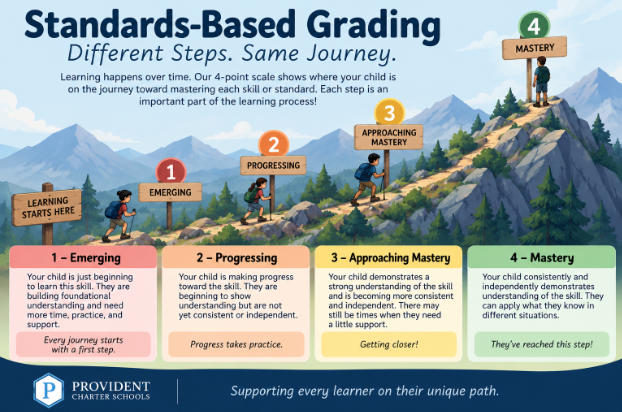
In Grades 1–3, students are graded on their progress toward specific grade-level learning targets rather than receiving only one overall letter grade for a content area. This gives families more detailed information about the individual skills and concepts their child has mastered and those that are still developing.
Students have multiple opportunities to demonstrate their learning. When determining a student’s level of proficiency on a standard, teachers consider the student’s strongest demonstration of learning from the three most recent opportunities. This means a student who struggles with a new skill at first has the opportunity to show that they have learned it later. The goal is to reflect what a student has learned—not simply average together every attempt they have made.
Grades 4–5 | Building Toward Traditional Grading
Grades 4 and 5 serve as a bridge between standards-based grading and the more traditional grading system students will experience in middle school. Students begin receiving traditional course grades, with different types of work contributing differently to the overall grade.
| Coursework Category | Grade 4 Weighted Value | Grade 5 Weighted Value |
| Tests | 40% of the total grade | 40% of the total grade |
| Quizzes | 15% of the total grade | 15% of the total grade |
| Independent Classwork | 35% of the total grade | 30% of the total grade |
| Projects & Presentations | 10% of the total grade | 10% of the total grade |
| Homework | Does not count toward total grade | 5% of the total grade |
Although we may begin assigning some minimal homework during Quarter 3 and Quarter 4 to build good work habits, homework does not count toward the Grade 4 academic grade. As students get older, expectations for independent practice and responsibility gradually increase.
Grades 6–8 | Middle School Grading
In middle school, grades increasingly reflect students’ ability to independently demonstrate what they have learned.
- Summative – 50%
Major demonstrations of learning, such as tests, writing, projects, presentations, and other culminating assessments. - Formative – 35%
Ongoing evidence of learning, including quizzes, independent classwork, and other checks for understanding. - Homework – 15%
Independent practice completed outside of class.
As students prepare for high school, greater emphasis is placed on independently applying what they have learned.
How Are Specials Graded?
Grades 1–3 Specials Classes | Standards-Based Approach
In Grades 1–3, Specials are standards-based. Rather than earning a traditional letter grade, students are assessed on specific skills and learning expectations for each Specials class. Teachers look at what students are able to understand, demonstrate, create, perform, and apply based on the learning goals for the course. Just like in their core academic classes, the goal is to give families useful information about the skills their child has developed and those that are still developing.
Grades 4–8 | Specials Grading
Beginning in Grade 4, students transition to traditional grades in Specials. These courses use a common grading structure:
| Category | Weighted Value | Explanation |
| Performance Assessments & Products | 40% of the total grade | Students demonstrate what they have learned through performances, projects, products, or skill demonstrations. |
| Daily Instructional Practice | 35% of the total grade | Students practice and apply the skills being taught during class. |
| Participation | 25% of the total grade | Students are assessed using a common participation rubric that looks at how they engage in and contribute to the learning activities of the class. |
Why Is Participation Part of a Specials’ Grade?
Active participation is often an important part of learning the skills taught in Specials. Students may need to participate in a physical activity, rehearse music, practice an artistic technique, work with materials, or contribute to a group activity in order to learn and demonstrate a skill.
Participation is not simply a grade for good behavior. Specials teachers use a common participation rubric so expectations are clear and grades are assigned consistently.
Students Are Not Graded on Talent
Students do not need to be the best artist, musician, athlete, or performer to earn a strong grade. Whether a student is in Grade 1 or Grade 8, Specials grades are intended to reflect learning and growth—not natural ability.
Beyond Our Walls Learning Initiative
At PCS we value the importance of immersive learning to connect to the community around us. Partnerships with educational organizations open up new pathways for student growth and provide students in grades 1-8 with opportunities that otherwise might not be available. These educational partnerships bring resources and guest speakers into the classroom which enhance student and community relationships. At Provident, we understand that not every student learns the same way. We value outreach programs that can reinforce learning concepts in the classroom in a creative, innovative, and hands-on approach. Some examples of community outreach programs that we have partnerships with include the Carnegie Museum of Natural History, The Holocaust Center of Pittsburgh through Chatham University, and the Asian Studies Center and Center of African Studies through the University of Pittsburgh.
Department of Curriculum, Instruction & Assessment